
Groundworks in Great Dunmow.
Groundworks contractors in Great Dunmow covering CM6 — strip and trench-fill foundations, drainage, concrete slabs and oversites, muck away, retaining walls, driveways and full site preparation across Felsted, Takeley, Little Dunmow and the surrounding villages. Groundworks from £950 — fully insured, own plant and operators, 4.9★ across 305+ reviews.
- Groundworks contractors covering CM6
- Own diggers, dumpers & grab lorries
- Licensed waste carrier — muck away included
- Building control inspections managed
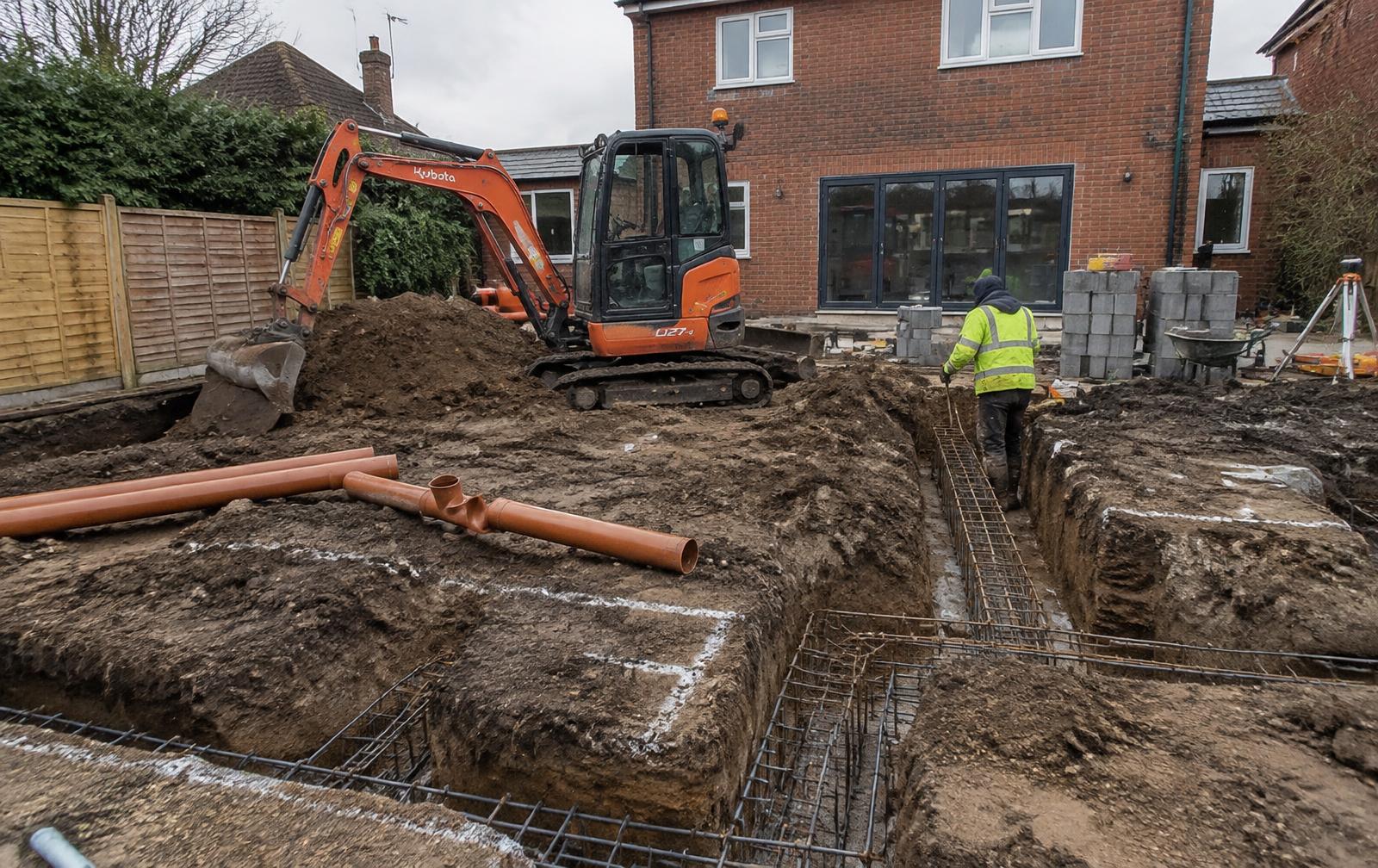
Groundworks services in Great Dunmow
- Strip, trench-fill & raft foundations
- Extension and new-build footings dug to engineer's depth
- Foul and surface water drainage, manholes & inspection chambers
- Soakaways, land drains & attenuation crates
- Concrete slabs, oversites & power-floated floors
- Site clearance, muck away & grab lorry hire
- Dig-outs, levelling, reduced dig & sub-base preparation
- Retaining walls, sleeper walls & gabion baskets
- Driveways, hardstandings & dropped kerbs
- Service trenches for water, gas, electric & ducting
- Piling co-ordination and ground beam preparation
- Underpinning and structural foundation repair
Groundworks contractors Great Dunmow rely on
Groundworks is the part of a build nobody sees and everything depends on. Get the footings, drainage and levels wrong in Great Dunmow and every trade after you pays for it. We dig, pour, drain and level to the drawings — and we're the ones building on top, so it has to be right.
Foundations
Trial holes first, then strip or trench-fill footings dug to the engineer's depth, steel reinforcement where specified, and C25–C35 concrete poured and vibrated. Every pour inspected and signed off by building control before we build off it.
Drainage
Foul and surface water runs laid to correct falls on pea shingle, with rodding access, inspection chambers, gullies and a full air test. Connections to the existing system or to the public sewer with a build-over agreement where needed.
Concrete slabs & oversites
Compacted MOT sub-base, sand blinding, DPM, insulation and mesh, then a poured and tamped or power-floated slab for extensions, garages, workshops and outbuildings.
Muck away & site clearance
Grab and tipper lorries, licensed waste transfer notes for every load, and contaminated-spoil disposal handled correctly. We clear vegetation, slabs, old sheds and concrete bases before the dig starts.
Dig-outs & levelling
Reduced-level digs for garden rooms, patios and driveways, sloping plots terraced and retained, and everything set out and laser-levelled rather than eyeballed.
Retaining structures
Reinforced concrete, engineering brick, blockwork and sleeper retaining walls with proper drainage behind and weep holes through — the part most failed garden walls are missing.
Driveways & hardstanding
Excavation to formation, geotextile membrane, MOT Type 1 in compacted layers, edge restraints and a base ready for block paving, tarmac, resin or concrete.
Service ducting
Trenching and ducting for water, electric, gas and data at the correct depths with warning tape, ready for the utility companies to connect.
How a Great Dunmow groundworks job runs
- Step 1
Free site survey
We walk the plot, check access for machines and lorries, look at ground levels, existing drainage and any trees or sewers that affect the dig.
- Step 2
Trial holes & ground check
Trial holes tell us the soil type and existing foundation depth. Essex clay, shrinkable soils and nearby trees all change the depth and cost — better to know before you're quoted.
- Step 3
Fixed written quote
Priced by the metre and the load — excavation, muck away, concrete, drainage and sub-base itemised separately so you can see exactly where the money goes.
- Step 4
Set out & excavate
Profiles and laser levels set out to the drawings, then excavation with mini diggers or 3–8 tonne machines depending on access.
- Step 5
Concrete & inspection
Building control inspects the open trench, then concrete is poured the same day so trenches never sit open and soften in the rain.
- Step 6
Drainage & sub-base
Drainage run in and air tested, backfill compacted in layers, sub-base laid and rolled to formation level and the site left clean and workable.
Digging in and around Great Dunmow
Every plot digs differently. These are the things that change the price and the programme on groundworks around Great Dunmow and CM6 — we check all of them at survey so the quote you get is the price you pay.
Essex clay & shrinkable soil
Most of the ground around Great Dunmow is shrinkable clay, which moves as it wets and dries. That normally means deeper footings — often 1.0–1.5m rather than the 600mm people expect — and the depth is set by the engineer and building inspector, not by guesswork.
Trees & root influence
A mature tree near the dig can push foundations to 2m-plus, or require trench-fill with a compressible board to one face. We identify root influence at survey so it isn't a surprise mid-build.
Existing drainage & sewers
Building within 3m of a public sewer needs a build-over agreement with Anglian Water. We survey the runs, lift chambers and apply for it early so it never holds up a start date.
Made ground & old bases
Old garage bases, filled ponds and rubble backfill are common on Essex plots. If trial holes hit made ground we'll price the dig-through honestly rather than discover it once the machine's on site.
Access & machine size
Plenty of properties around Great Dunmow have narrow side access. We use 0.8t micro and 1.5t mini diggers where needed and barrow or conveyor spoil out, so a tight terrace is still workable.
Water table & soakaways
Percolation testing before a soakaway goes in — on heavy clay a soakaway often won't work and surface water needs a different solution. We test rather than assume.
Why use us for groundworks in Great Dunmow
Own machines and operators
Micro, mini and 3-tonne excavators, dumpers, rollers and compaction plant in-house — no waiting on a hire yard and no plant-hire mark-up on your bill.
Licensed waste carriers
Every load removed with a waste transfer note. No fly-tipped spoil in your name and no surprise tip charges after the event.
We build on our own groundworks
We're extension and brickwork builders too, so the footings are set out for the structure that's going on top — level, square and the right width first time.
Building control liaison
We book inspections, meet the inspector on site and keep the paperwork, so every stage is signed off properly.
£5m public liability & full RAMS
Insured, CSCS-carded, with proper trench support, edge protection and a safe, tidy site.
4.9★ from 305+ reviews
Family-run, local, and trading on reputation across Colchester and Essex.
Groundworks in Great Dunmow & across CM6
- Great Dunmow
- Felsted
- Takeley
- Little Dunmow
- Stebbing
Building on top as well? Extension builders in Great Dunmow → · Bricklayers in Great Dunmow →
Groundworks in other towns we cover
- Groundworks Colchester
- Groundworks Chelmsford
- Groundworks Ipswich
- Groundworks Braintree
- Groundworks Clacton-on-Sea
- Groundworks Witham
- Groundworks Maldon
- Groundworks Halstead
- Groundworks Sudbury
- Groundworks Harwich
- Groundworks Tiptree
- Groundworks West Mersea
- Groundworks Holland-on-Sea
- Groundworks Manningtree
- Groundworks Kelvedon
- Groundworks Coggeshall
- Groundworks Earls Colne
- Groundworks South Woodham Ferrers
- Groundworks Southend-on-Sea
- Groundworks Leigh-on-Sea
- Groundworks Westcliff-on-Sea
- Groundworks Hatfield Peverel
- Groundworks Danbury
- Groundworks Brentwood
- Groundworks Haverhill
- Groundworks Hadleigh
- Groundworks Dedham
- Groundworks Billericay
- Groundworks Wickford
- Groundworks Mayland
Groundworks Great Dunmow — your questions answered
How much do groundworks cost in Great Dunmow?+
Small groundworks jobs in Great Dunmow start from around £950. As a guide, extension footings typically run £160–£260 per linear metre depending on depth and access, a concrete slab and oversite around £120–£180 per m², and drainage roughly £90–£150 per metre of run. Muck away is priced per grab or tipper load. You get a fixed written quote after trial holes.
How deep do foundations need to be in Great Dunmow?+
On the shrinkable clay common around Great Dunmow the usual depth is 1.0–1.5m, and deeper again where trees are close. The final depth is decided by the building inspector and structural engineer after trial holes — we never pour until the trench has been inspected.
Do you do muck away and site clearance?+
Yes. We remove spoil, concrete, rubble and vegetation with grab and tipper lorries as licensed waste carriers, with a waste transfer note for every load from your Great Dunmow site.
Can you get machines into a tight or rear garden?+
Usually yes. We run micro diggers from 0.8t that fit through a standard side gate, plus tracked barrows and conveyors for spoil. Where there's genuinely no access we'll tell you at survey and price hand-dig honestly.
Do I need a build-over agreement?+
If you're building within 3m of a public sewer, yes — it's applied for through Anglian Water. We identify sewer runs at survey and get the application in while drawings are being prepared so it doesn't delay the start.
Do you install drainage and soakaways?+
Yes — foul and surface water drainage, inspection chambers, gullies, land drains, attenuation crates and soakaways. We percolation-test before specifying a soakaway, because on heavy Essex clay they often don't work and another solution is needed.
How long do groundworks take on an extension?+
For a typical single-storey extension in Great Dunmow, groundworks are usually 1–2 weeks: setting out and dig, inspection and pour, drainage, then blockwork up to DPC and the oversite slab. Larger or deeper digs and difficult access add time.
Do you do underpinning and foundation repairs?+
Yes — traditional mass concrete underpinning in sequenced bays, plus foundation repairs where subsidence, root damage or old shallow footings have caused movement. Always to an engineer's design and inspected as work proceeds.
Are you insured and guaranteed?+
Yes — £5m public liability, full RAMS and method statements, licensed waste carrier registration, building control sign-off at every stage and a written workmanship guarantee. Rated 4.9★ across 305+ reviews in Colchester, Essex and the surrounding area.
What areas around Great Dunmow do you cover?+
CM6 — Great Dunmow, Felsted, Takeley, Little Dunmow, Stebbing and the surrounding villages.
Free groundworks quote in Great Dunmow
Same-day call back across CM6.